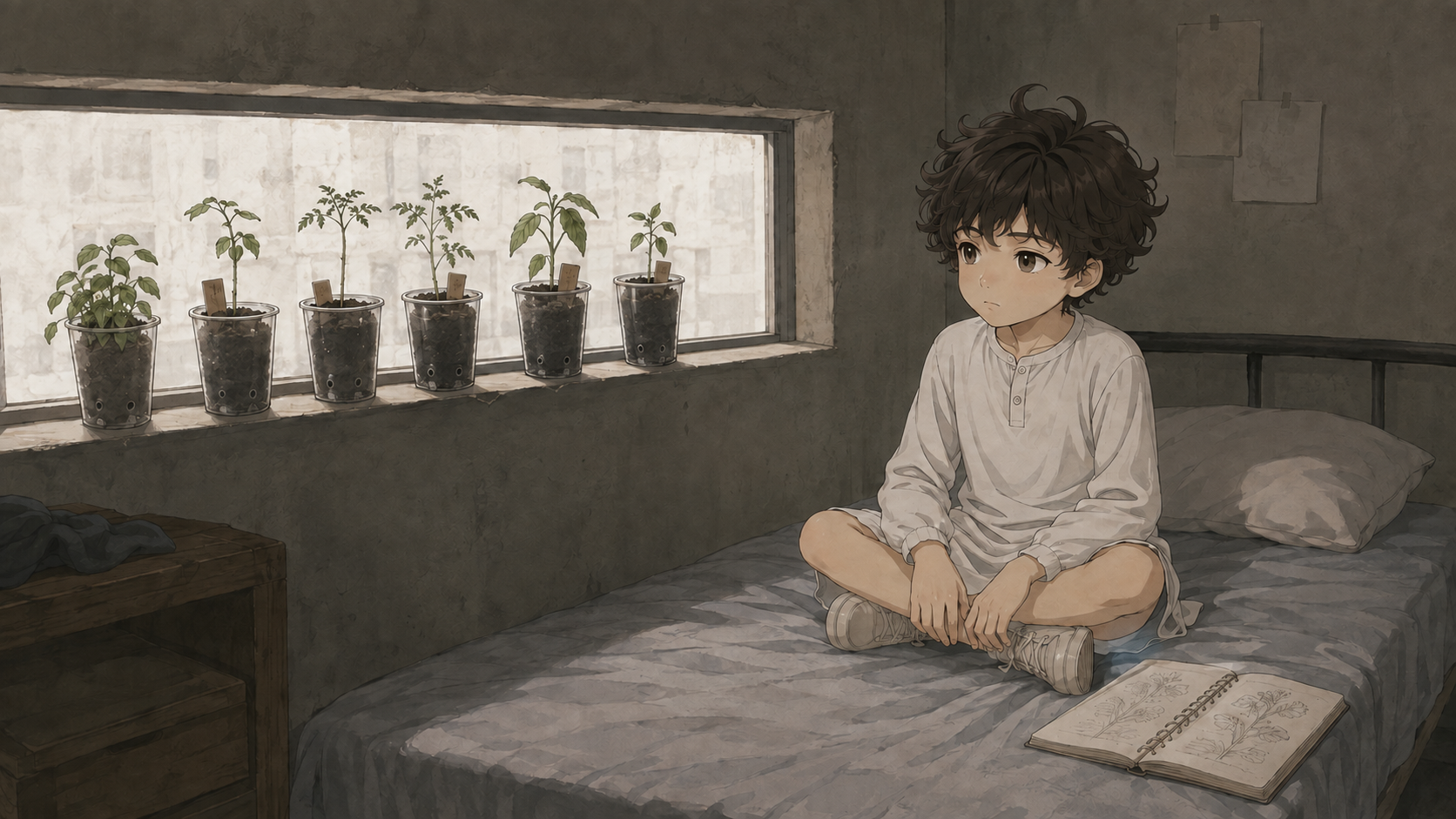
Before Lumen understands the larger forces moving around him, he does something small and deeply human: he names every plant on his windowsill.
There are six plants in all. Mercy. Samson. June. Each name turns an overlooked living thing into someone worth noticing. For a boy still looking for home, that ritual says more than a speech could.
This article discusses the opening of The Othering: Book One — The Witness but avoids major plot revelations.
Naming is a form of attention
To name something is to separate it from the blur of everything else. The plant is no longer just part of the room. It has an identity, a history, and a particular way of responding to the light.
Lumen watches closely enough to recognize those differences. He notices leaning, curling, yellowing, reaching, and waiting. Where another person might see decoration, he sees communication.
That does not mean the plants speak to him in an ordinary voice. It means he has developed a language of care. He pays attention to small changes because small changes are often how living things tell the truth.
A boy without a home makes a garden
Lumen begins the story at Safe Havens. Even the name carries a tension: a place can offer shelter without yet feeling like home.
The windowsill garden gives him a small territory of relationship. He cannot control the whole building or decide what comes next, but he can remember which plant needs water. He can notice which one is struggling. He can return tomorrow.
That repetition matters. Home is often imagined as a location, but for Lumen it begins as a practice. You come back. You pay attention. You learn what another living thing needs. You keep showing up.
The names reveal the person doing the naming
Names are never neutral in fiction. Even when they are playful, they reveal the namer’s hopes and categories. Mercy suggests gentleness or forgiveness. Samson suggests strength. June carries warmth, season, and the promise of growth.
The plants become a vocabulary Lumen can use before he has language for everything happening inside him. Through them, he can imagine strength without hardness, mercy without pity, and growth that arrives slowly rather than all at once.
The important point is not to lock each name into a single answer. Symbols stay alive when they can hold more than one meaning. The names create a field of possibilities around Lumen—and invite the reader to notice which meaning becomes important to them.
Care is one of Lumen’s first powers
Fantasy often introduces power through force: a weapon appears, a spell erupts, an enemy is defeated. The Othering begins closer to the soil.
Lumen’s first defining ability is attention. He recognizes life where others might pass without looking. He notices response. He cares before he knows whether caring will protect him.
That makes the garden more than a symbol of innocence. It becomes an early model for power in this world. Power may begin as the capacity to remain present with something fragile.
Naming and the fear of being unnamed
There is another side to the ritual. A child who insists on naming overlooked things may understand, even without saying it, what it feels like to be reduced to a category.
“Othering” is the act of turning a person into a type that can be kept at a distance: not one of us, not fully known, not worth the same attention. Naming can do the opposite when it is offered with care. It can say: you are particular. You are not interchangeable. I have noticed you.
Lumen’s garden therefore carries the central question of the book in miniature. What changes when someone the world has overlooked begins to recognize overlooked life everywhere?
Why the scene matters later
The opening prepares the reader to watch for a recurring language: roots, memory, waiting, growth, and hidden connection. The windowsill is small, but the idea underneath it is not.
A root can travel where the eye cannot. A plant can turn toward a source of light before anyone else notices the light has changed. A garden can remember the hands that tended it.
Those are not plot answers. They are reading instructions. Lumen’s plants teach us how to approach the world of The Othering: pay attention to what leans, what waits, and what keeps trying to grow.
Meet Lumen
Read the opening chapter free
Begin at the windowsill with “The Boy Looking for Home.” No account or purchase is required.
A reader question: Which name—Mercy, Samson, or June—would make you stop and look twice?

